Research & Resources
Original research, the history of the vote, and the facts on Automatic Voter Registration.
Our Resources
iVote Civic Education Fund conducts nonpartisan research to measure public opinion on election and voting issues.
Our surveys of swing state voters have measured what Americans want from the officials who run their elections. The findings are consistent: voters want a secretary of state who acts in a fair, nonpartisan manner and accepts election results, and they prioritize increasing access to the ballot. These findings shape our public education campaigns.
iVote Research
Americans’ views on elections, voting and reforms.
iVote Research polls voters on how elections are run, then sits down with them in focus groups to find out what is behind the numbers.
This project is about countering misinformation and putting facts and data behind the conversation about how we make our elections work better and ensure every eligible American has the opportunity to vote.
National Voter Survey
What Americans say about the rules of voting
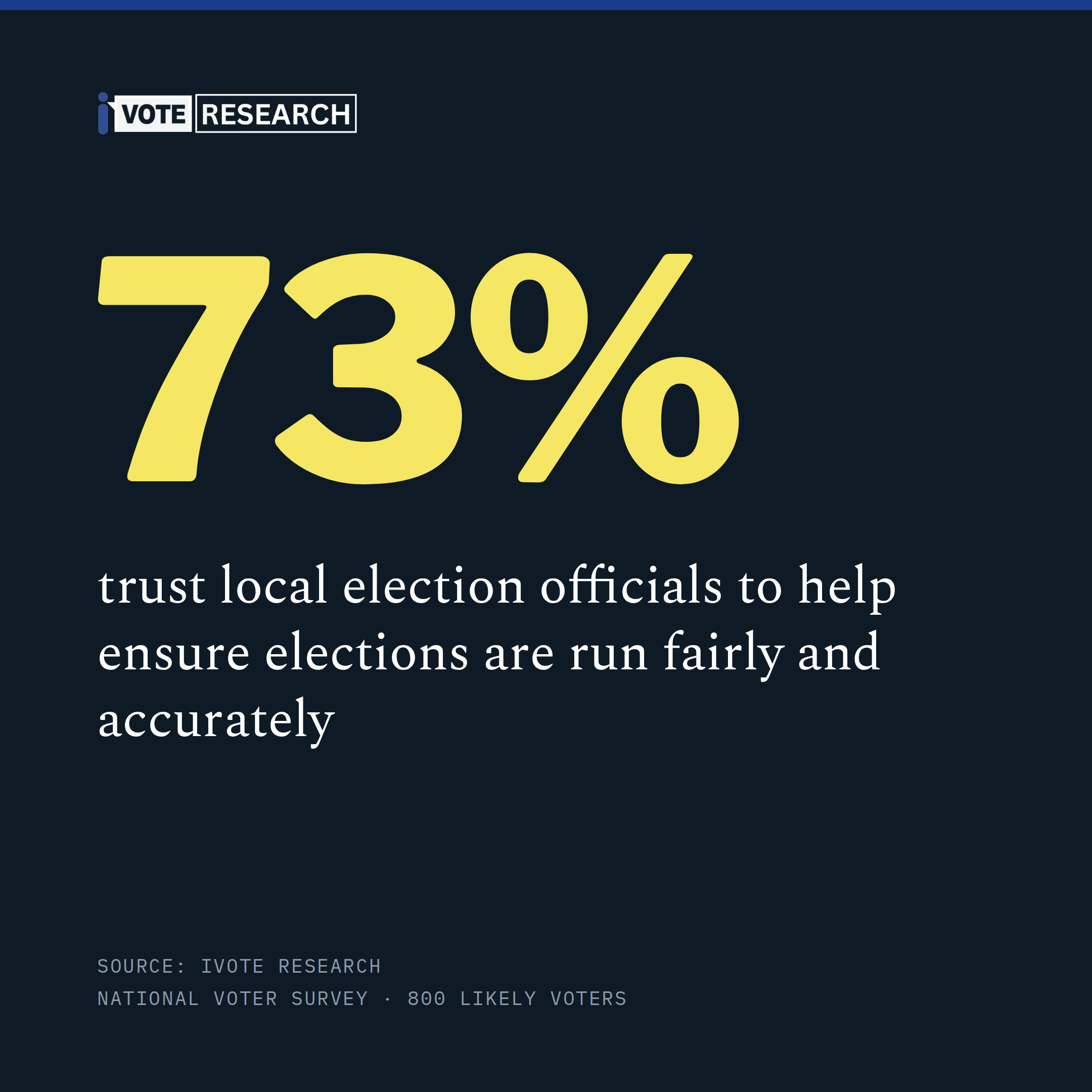
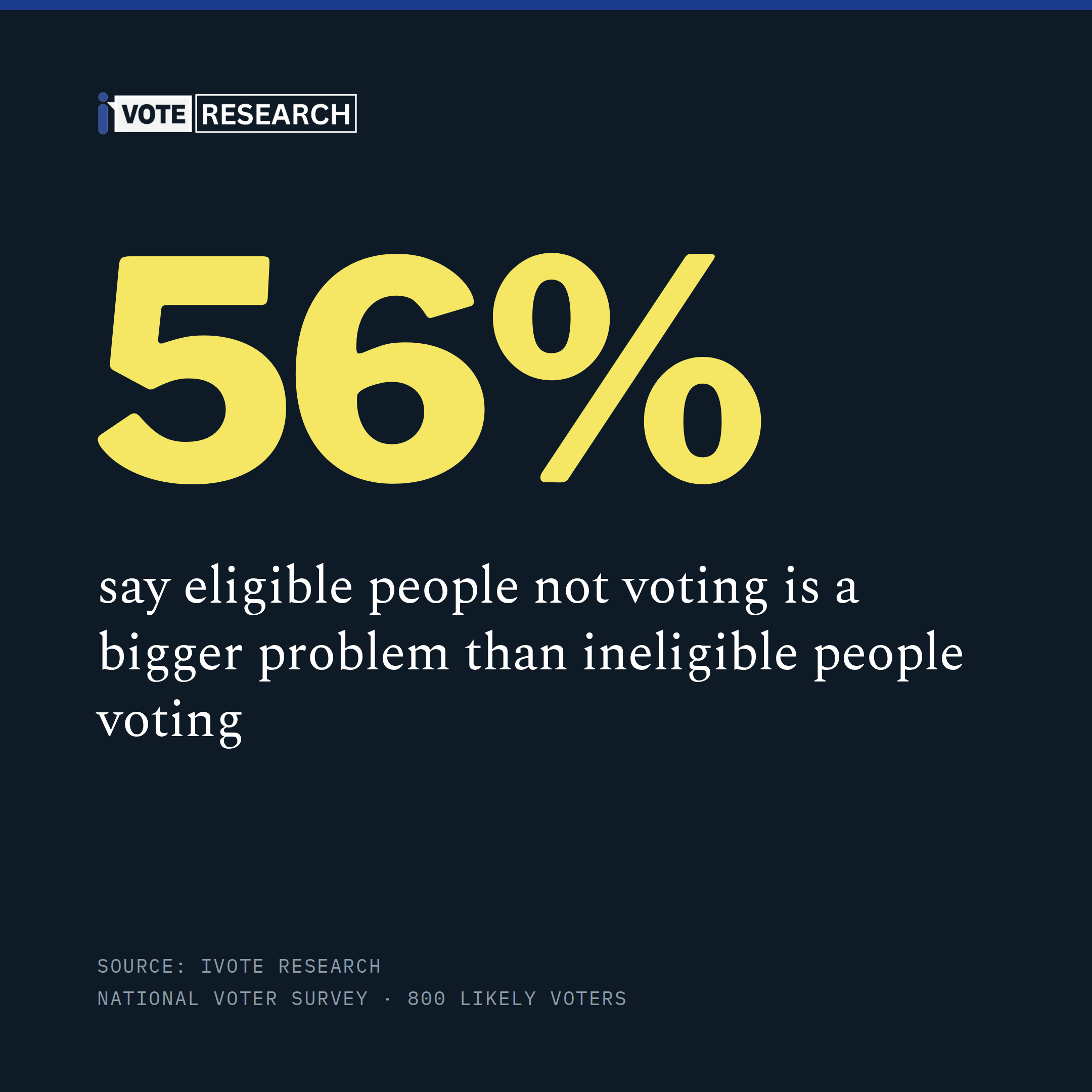
iVote Research commissioned a national survey of likely November 2026 voters on issues around voting and elections.
Read the report →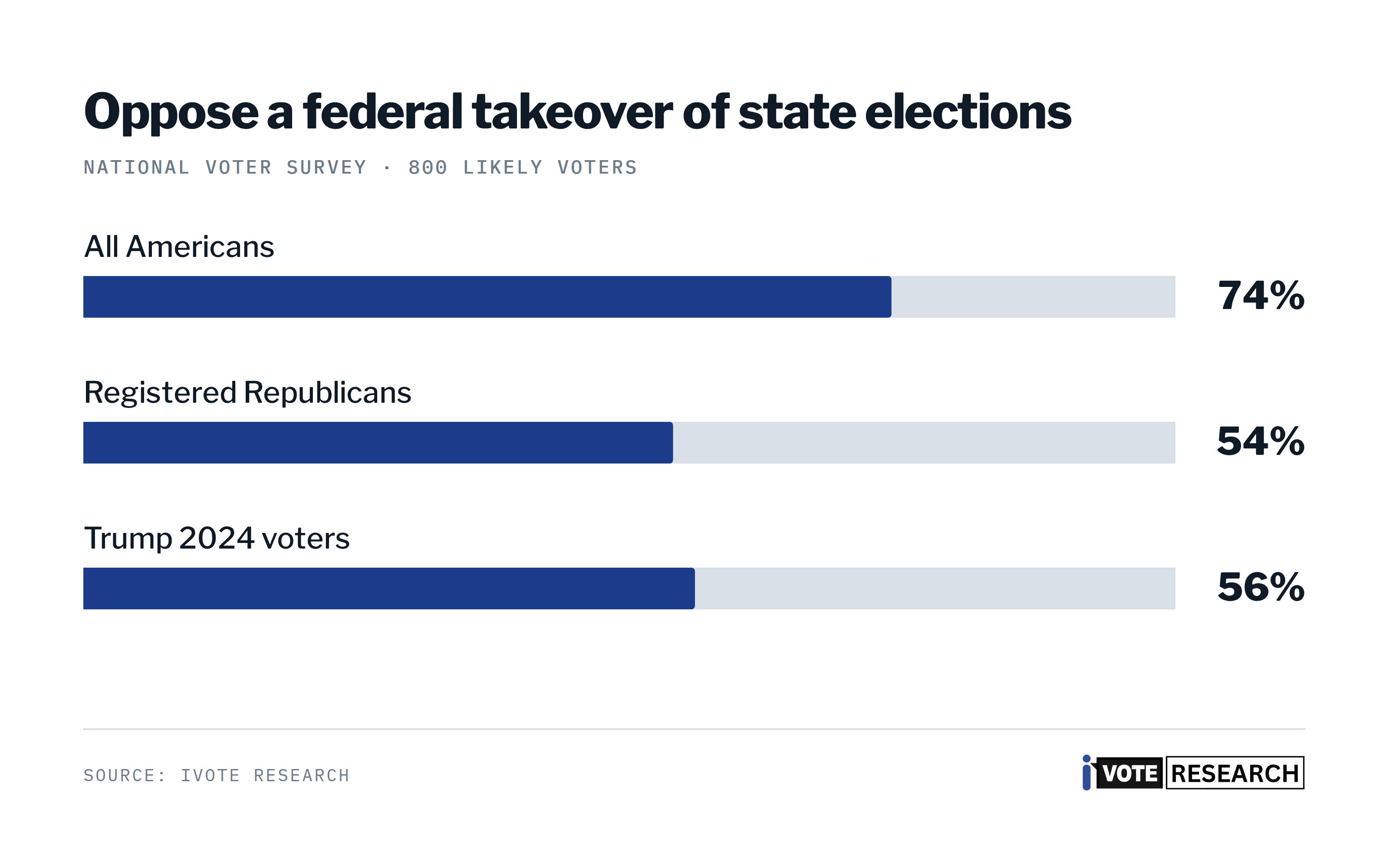
Research Insights
Short reads on what the research found, plus the newsletter, for anyone working against a deadline.
Content →Voting Rights Timeline
Two centuries of expansion, and a contested last decade.
Narrowed protections
The Constitution is ratified, leaving voter eligibility to the states. In practice, the vote is generally limited to white, property-owning men, with exceptions in a handful of states.
New Hampshire becomes the first state to eliminate its property requirement for voting. Vermont had entered the Union the year before with no property requirement at all.
Maryland becomes the last state to remove religious restrictions on voting.
The first women's suffrage convention convenes in Seneca Falls, NY. 68 women and 32 men sign the Declaration of Sentiments and Resolutions, calling for equal treatment under the law and voting rights for women.
North Carolina becomes the last state to eliminate property requirements for voting.
The Civil Rights Act of 1866 grants citizenship, but not the right to vote, to all persons born in the U.S. The Fourteenth Amendment is ratified, guaranteeing "equal protection of the laws" to all persons born or naturalized in the United States.
The Fifteenth Amendment is ratified. The right to vote is extended to all male citizens regardless of "race, color, or previous condition of servitude." In practice, poll taxes, literacy tests, and violence keep most Black Americans from the ballot for nearly a century.
In Guinn v. United States, the Supreme Court strikes down grandfather clauses.
The Nineteenth Amendment is ratified. The right to vote is extended to all citizens regardless of gender.
The Indian Citizenship Act declares all Native Americans born in the U.S. to be citizens with the right to vote.
Court rulings in Arizona and New Mexico strike down state laws denying Native Americans the right to vote. Utah, the last state with such a law, removes its restriction in 1957.
The Civil Rights Act of 1957 authorizes the U.S. Attorney General to file lawsuits on behalf of African Americans denied the right to vote.
The Civil Rights Act of 1960 makes collection of state voter records mandatory and authorizes federal investigation of state voter data for civil rights litigation.
The Twenty-fourth Amendment outlaws poll taxes in federal elections. The Supreme Court establishes one person, one vote as the national standard in Reynolds v. Sims. President Johnson signs the Civil Rights Act of 1964.
Civil rights activists marching from Selma to Montgomery are attacked by state troopers on the Edmund Pettus Bridge. Months later, the Voting Rights Act of 1965 is signed into law. It prohibits any election practice that denies the vote on the basis of race and requires jurisdictions with histories of discrimination to obtain federal approval, called preclearance, before changing their election laws.
The Supreme Court upholds the Voting Rights Act in South Carolina v. Katzenbach and strikes down state poll taxes in Harper v. Virginia State Board of Elections.
Congress renews the Voting Rights Act and suspends literacy tests nationwide. The Twenty-sixth Amendment extends the right to vote to all citizens age 18 and over.
Congress extends the Voting Rights Act, makes the ban on literacy tests permanent, and mandates assistance for language minority voters.
Congress extends the Voting Rights Act for 25 years and amends it to allow findings of discrimination without proof of discriminatory intent.
The Americans with Disabilities Act requires that polling places and election services be accessible to voters with disabilities.
The National Voter Registration Act ("Motor Voter") requires states to offer mail-in registration and registration services at DMVs and other state agencies.
The Help America Vote Act sets minimum standards for election administration, establishes provisional ballots, and funds upgrades to state voting systems.
The Voting Rights Act is extended for another 25 years, passing the Senate 98 to 0.
The Military and Overseas Voter Empowerment Act makes it easier for troops stationed overseas and Americans abroad to request and receive absentee ballots.
In Shelby County v. Holder, the Supreme Court strikes down the Voting Rights Act's coverage formula, ending federal preclearance in practice. States previously covered begin enacting voting changes without federal review.
Oregon becomes the first state to pass automatic voter registration, implementing it in 2016. New registrations grow nearly four-fold in the law's first year.
Florida voters approve Amendment 4, restoring voting rights to an estimated 1.4 million people with past felony convictions, the largest single expansion of the franchise in decades.
Amendment 4 takes effect in January. In June, the Florida legislature conditions restoration on payment of all court fines and fees, a requirement upheld by a federal appeals court in 2020.
Amid the COVID-19 pandemic, states expand mail and early voting on a large scale. More than 158 million Americans vote, the highest raw turnout in American history, with turnout reaching 66.6% of eligible voters.
In Brnovich v. DNC, the Supreme Court narrows the standard for challenging voting restrictions under Section 2 of the Voting Rights Act. The same year, at least 19 states enact 34 laws restricting access to voting while 25 states enact laws expanding it.
Congress passes the Electoral Count Reform Act, clarifying that the vice president's role in counting electoral votes is solely ministerial and raising the threshold for congressional objections from one member of each chamber to one-fifth of each chamber.
In Allen v. Milligan, the Supreme Court upholds Section 2 of the Voting Rights Act, ruling that Alabama's congressional map likely diluted Black voting power. Minnesota and New Mexico restore voting rights to citizens upon release from incarceration. Minnesota and Pennsylvania adopt automatic voter registration, and Delaware's 2021 law takes effect.
More than 156 million Americans vote, the second-highest total in American history. More than 85% of voting-age citizens are registered, and the number of registered voters reaches an all-time high of 211 million.
The Supreme Court decides Louisiana v. Callais, ruling 6 to 3 that the Voting Rights Act did not require Louisiana's majority-minority district and that the map was an unconstitutional racial gerrymander. The decision significantly narrows vote-dilution claims under Section 2. It is the most significant narrowing of the Voting Rights Act since Shelby County v. Holder, and its effects on redistricting cases nationwide are still unfolding.
Automatic Voter Registration Fact Sheet
Updated July 2026
Voter Registration and Turnout
- More than 156 million Americans voted in the 2024 election, the second-highest total in American history. That still means roughly one in three eligible voters, nearly 88 million people, did not cast a ballot.1
- Registration remains the biggest single barrier. In a 2020 Medill/NPR/Ipsos survey of nonvoters, 29% said the main reason they did not vote was that they were not registered.2
- The gap falls unevenly. Americans who are not registered are disproportionately low-income voters, people of color, and young people.3
- Registration deadlines alone keep millions home. A study of Google search data from the 2012 election found that three to four million eligible Americans searched for registration information after their state's deadline had passed, and would have registered in time to vote if deadlines had extended to Election Day.4
Automatic Voter Registration Works
- When Oregon became the first state to implement AVR in 2016, new registrations grew nearly four-fold, from roughly 2,000 per month before the law to a monthly rate almost four times higher.5
- Nevada's AVR system, approved by voters as Question 5 in 2018, took effect in January 2020 and added more than 323,000 new voters in its first two years, driving the state to an all-time high in active registered voters. In November 2020, a record 1,407,754 Nevadans cast ballots.6
- AVR also keeps voter rolls accurate. Because the process updates existing registrations with current addresses, it reduces provisional ballots and the administrative cost of maintaining lists.7
Automatic Voter Registration is Cost Effective
- The annual county-level cost of voter registration nationwide has been estimated at $1 billion, roughly one-third of the total county-level cost of administering elections. Electronic registration reduces that cost.9
States with Automatic Voter Registration
- 24 states and the District of Columbia have enacted or implemented automatic voter registration.7
- Oregon started it in 2015. Since then, states red and blue have followed, including West Virginia (2016), Georgia (2016), Alaska (by ballot measure, 2016), Illinois (2017), Michigan (by ballot measure, 2018), Virginia (2020), and Hawaii (2021).
- The most recent additions are Delaware (enacted 2021, implemented 2023), Minnesota (2023), New Mexico (enacted 2023, implemented 2025), and Pennsylvania, which implemented AVR administratively in 2023. New York enacted AVR in 2020 and began implementation in 2025.7
- States take two basic approaches. Some ask the question at the counter: when you do business at the DMV, a screen asks whether you want to register, and you say yes or no on the spot. Others register you automatically and mail you a notice afterward with the option to opt out. Either way, the burden shifts from the voter to the system.7
Sources
- University of Florida Election Lab, 2024 general election turnout data (156,766,239 ballots counted; 64.07% of eligible voters)
- Medill School of Journalism/NPR/Ipsos survey of 2020 nonvoters, fielded November 4–13, 2020
- U.S. Census Bureau, Current Population Survey, Voting and Registration Supplement
- Street, Murray, Blitzer & Patel, "Estimating Voter Registration Deadline Effects with Web Search Data," Political Analysis 23(2), 2015
- Brennan Center for Justice analysis of Oregon Secretary of State data, 2016
- Nevada Secretary of State; The Nevada Independent analysis of registration data, January 2020 through December 2021
- National Conference of State Legislatures, "Automatic Voter Registration," updated July 2025 (ncsl.org)
- Brennan Center for Justice, "Voter Registration in a Digital Age," 2010
- "The Costs of Modernizing Voter Registration Systems" (ACLU-commissioned report, SSRC/Measure of America, 2015), building on Caltech/MIT Voting Technology Project estimates